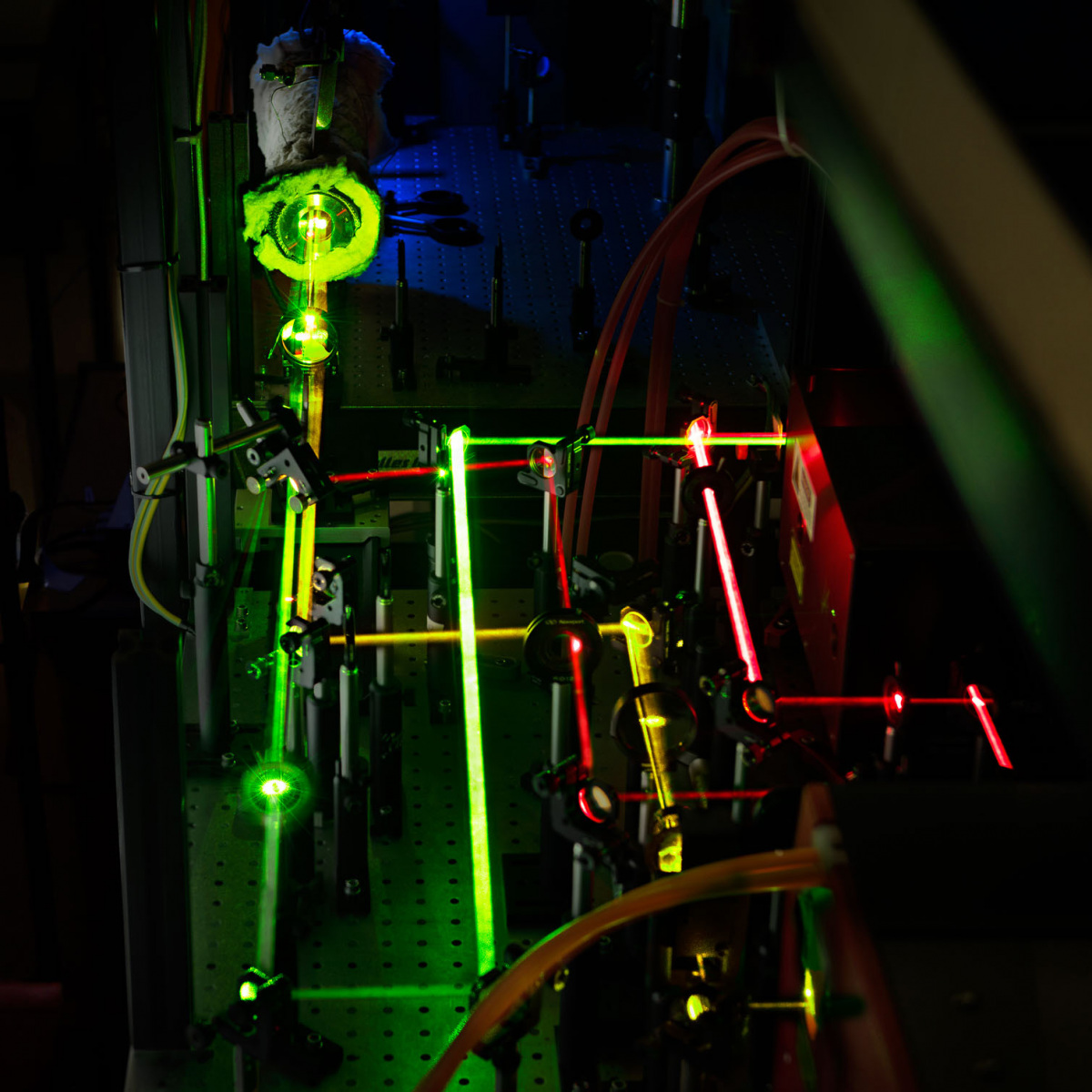
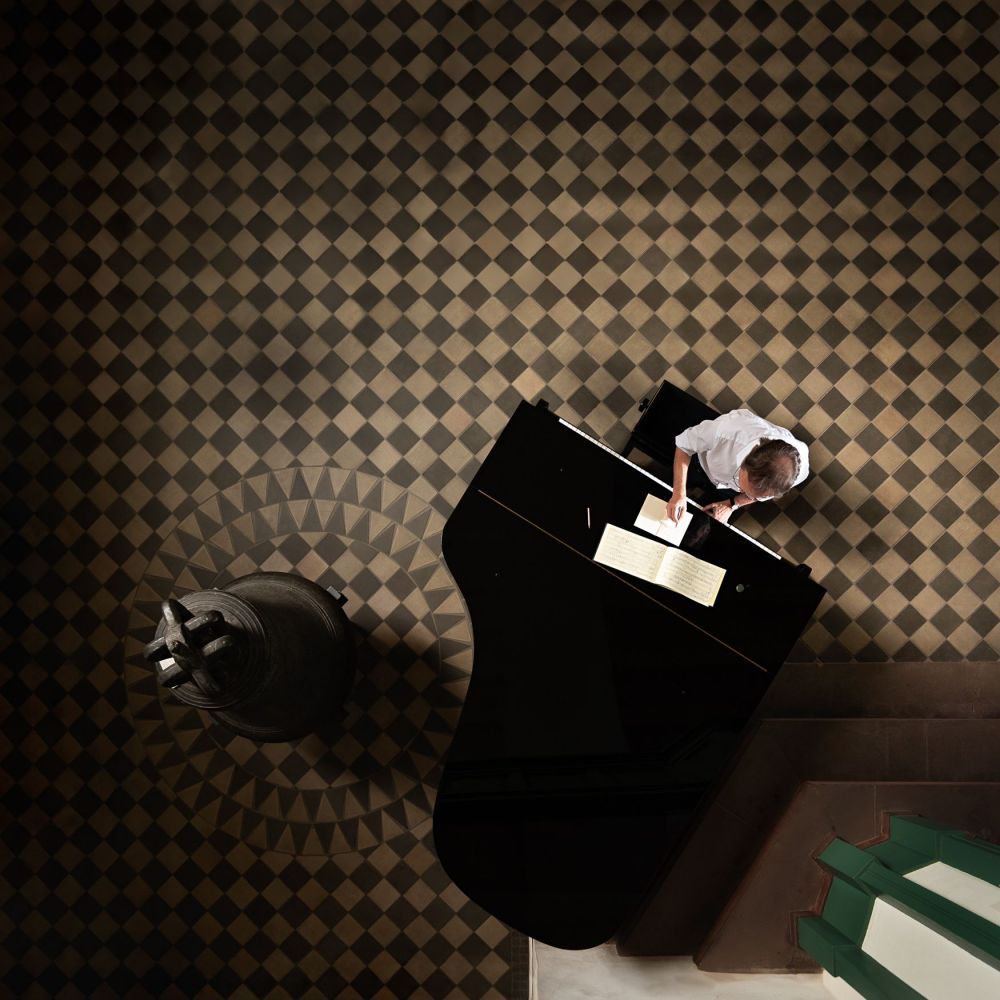
Capturing the Coherent Anti-Stokes Raman Scattering (CARS) setup at ZESS required specific technical interventions to make the laser light’s path visible within the frame. I worked closely with PhD student Evaggelos Sidiropoulos. We met two weeks before the shoot which gave him enough time to kindly removed the racking, allowing for a strong overhead perspective. When he first turned the lasers on, the environment presented a significant visual density – defined by bright flashes and a rhythmic pulse from the pump lasers reminiscent of a 1990s discotheque.
Tangible Tension
To document the order behind this complex system, I suspended two kilograms of camera and lens directly above months of delicate calibration work, introducing a tangible tension to the process; These pulsed beams are (unlike public transport) delayed with extreme precision to ensure they travel the exact same distance before hitting the final lens.

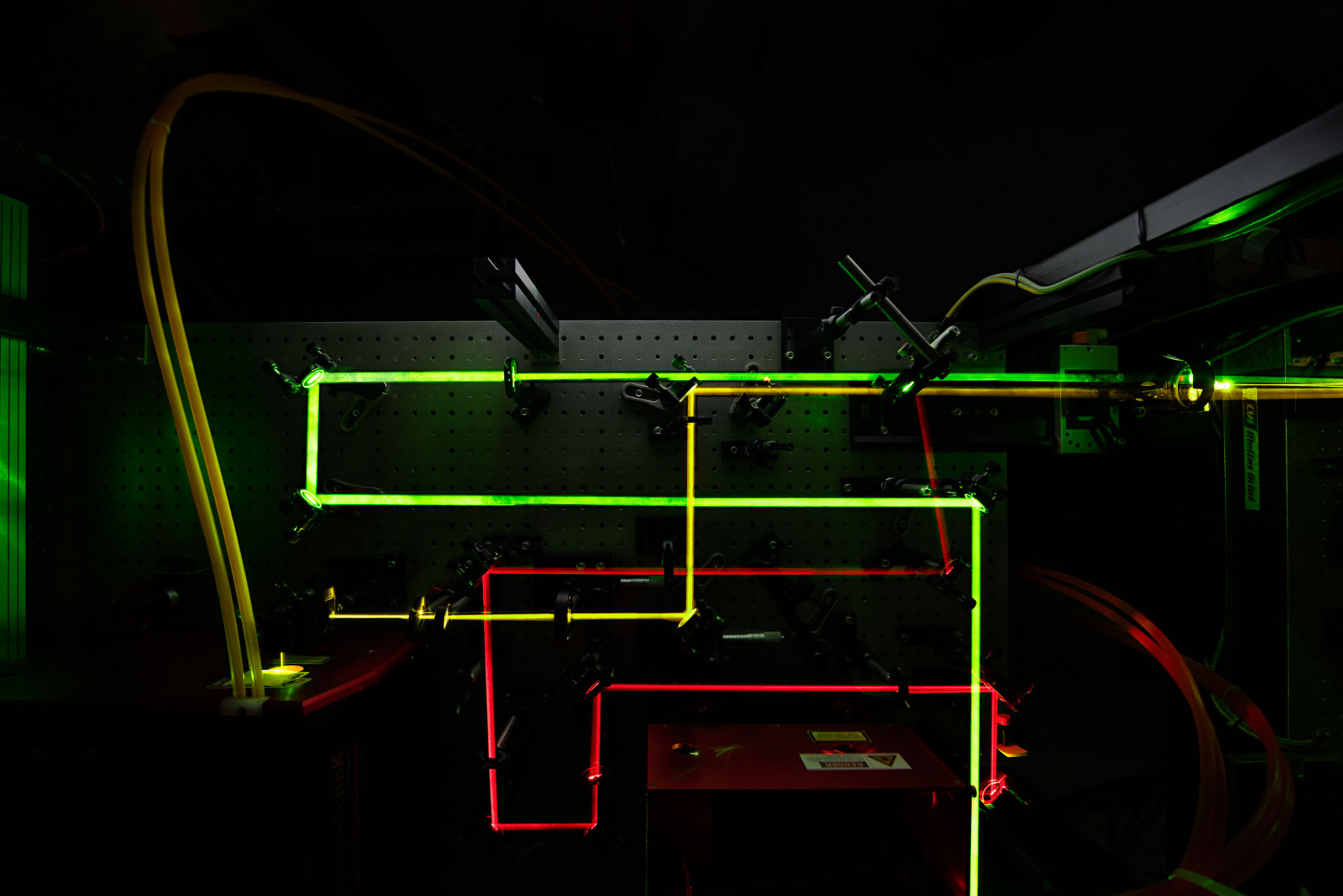
The technical challenge for me lay in the disparity between the intensity of the lasers and their lack of visibility. I opted for a composite technique, establishing a base layer with studio flash before blending several exposures where smoke was introduced to give the photons something to reflect from. The beams pulsate so rapidly that only fragments are ever present, so several exposures were necessary to create the complete paths. Because the CARS process creates a blue beam for the Raman spectroscopy that is too faint to be captured naturally, I introduced a blue-gelled flash as a finishing touch to represent this critical final stage of the optical journey. This method of layering disparate moments into a single frame allows the viewer to trace the synchronized convergence of light that remains otherwise lost to the human eye.
Technical Background
The underlying architecture of this dual-pump vibrational CARS probe relies on the interaction of light and matter through a nonlinear four-wave mixing process. A seeded, frequency-doubled Nd:YAG laser acts as the central engine, pumping both broadband and narrowband dye lasers to generate the specific Stokes and probe beams required for spectroscopy. These beams follow intricate delay lines – essential for achieving the temporal overlap of pulses – before converging in a folded BOXCARS configuration. It is here, within the focal point of a heated gas cell, that the three primary beams interact to produce a fourth signal: a blue beam containing the spatially and temporally resolved thermodynamic data of the medium. Ongoing developments aim to integrate a rotational CARS setup, which will broaden the spectral range to capture the signatures of molecules such as CO2 and H2.
These images document the specialized laser configurations at the Center for Sensor Systems (ZESS). For the official project feature, including a technical summary of the setup and contact details for the research group, visit the Dual-Pump Vibrational CARS Overview at ZESS, Uni Siegen.