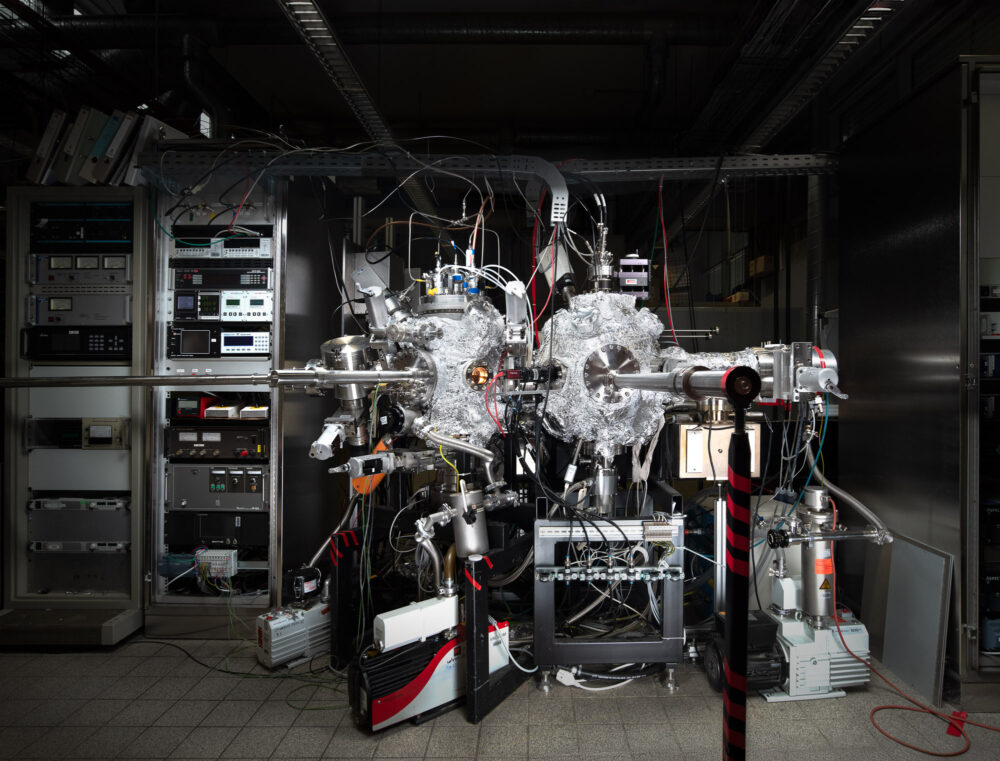
In the realm of high-stakes research, the equipment is often as complex as the data it produces. Recently, I had the opportunity to photograph a truly remarkable Physical Vapour Deposition (PVD) system – a one-of-a-kind installation in Europe. Located at Prof. Jiang’s chair of Materials and Surface Technology housed within the ZESS building, this system represents the pinnacle of thin-film coating technology, and capturing it required a blend of technical patience and visual strategy.
The Mechanics of Thin-Film Innovation
The system is a mechanical duality. On the left, the PVD coating chamber operates under an ultra-high vacuum, where four different cathodes sputter thin films onto samples. These can be used individually or in combination with various gases to create specific material properties. On the right, connected by magnetic slide valves, sits the secondary electron measurement chamber. Here, an electron beam is fired at the sample from an electron gun. The fast primary electrons penetrate the surface and generate a large number of slow electrons in the first few nanometres. Some of these slow electrons leave the sample and can be measured; these are known as secondary electrons.
Translating Complexity into Visual Strategy
Photographing such a system in a functional, high-output lab environment presents a specific challenge. By nature, these spaces are dense with instrumentation – a hive of activity where every cable and peripheral device has a vital purpose. However, to truly honour the engineering with the aesthetics it deserves, a degree of “visual decluttering” is essential.
My goal was to refine the composition to ensure the viewer’s eye isn’t lost in the surrounding context. I utilised a composite approach, capturing multiple frames to blend the lighting precisely. This technique allows me to highlight the elegant geometry of the stainless steel and vacuum flanges, rendering them with the same level of detail that the scientists apply to their thin-film layers.
Patience and Precision
In science, as in photography, one cannot rush results; quality does not manifest faster simply because one is impatient. The success of a shoot like this relies heavily on the people behind the machines, and I am particularly grateful that Stefan Wagener, the responsible lab engineer, humoured my process. His immense patience allowed us to find the perfect angles and lighting setups without disrupting the integrity of the workspace.
There is a certain professional satisfaction in knowing that the final image was chosen by Prof. Xin Jiang’s chair for their christmas card. It serves as a subtle reminder that when we bridge the gap between high-level research and corporate aesthetics, the result is more than just a technical record – it becomes a piece of visual communication that resonates across the department.
- For the open-jet wind tunnel production that resulted from a lunch break encounter directly related to the PVD-shoot, see the post “A speedlight, a Naked Bike, and a Currywurst Walk into a Wind Tunnel”