To document the Hitchhiker II passive radar setup at ZESS in its natural habitat, we had to transport the GPS unit and the central receiver box affectionately dubbed the ark by the scientists (I presume for its considerable weight) to the roof. Beyond the physical exertion, this beautiful team-building exercise involved lab engineer Arne Stadermann, a foldable ladder, an improvised pulley system, and significant nervous strain on my part, as Dr Holger Nies – head of the radar lab at ZESS and the supervising scientist – casually mentioned that a single module in the ark represented a six-figure investment
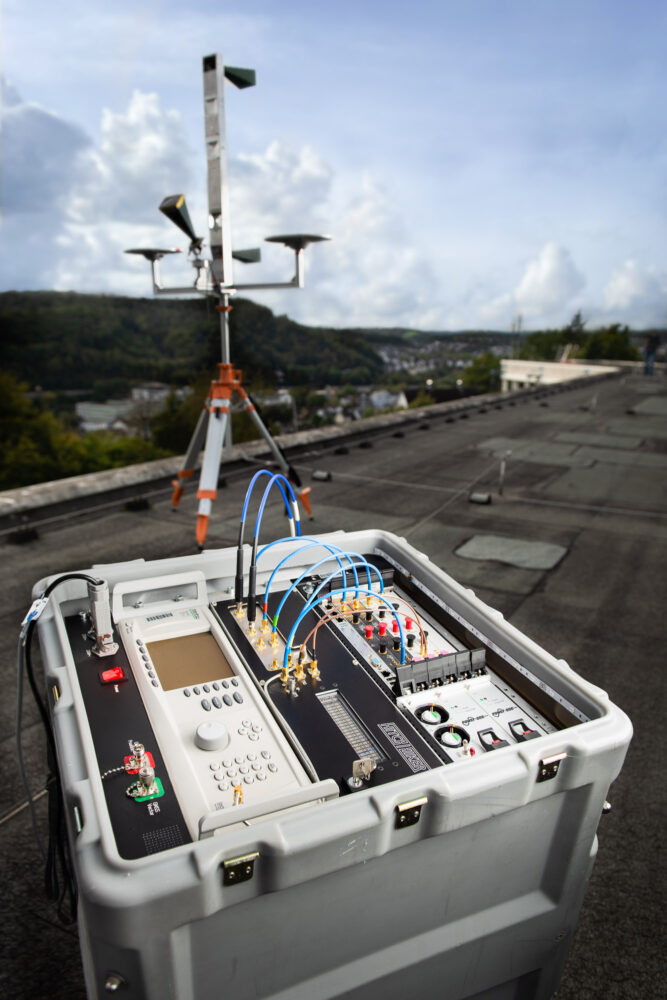
Environmental variables then made things worse by demanding speed. Although we initiated the session under a sky of compelling texture, the rapid onset of shifting cloud cover quickly narrowed the window before the backdrop dissolved into a dull, uniform grey. I had also deployed a very large supported scrim, a setup with a quality inversely proportional to the increasing wind speed, particularly because the support was provided by Holger himself.
There is a quiet satisfaction in these moments of shared effort, where the technical complexity of the sensor meets the elemental challenge of the rooftop, especially once you’re safely back inside with the equipment secured and the intended frames captured.
Technical background
The HITCHHIKER project, established at ZESS in 2009, serves as a high-resolution receiver system designed for bistatic experiments using the German TerraSAR-X system as an illuminator. Since its inception, the system has evolved from a stationary receiver to a fully operational active bi- or monostatic radar sensor. This modular architecture allows for the acquisition of high-resolution digital elevation models (DEMs) and offers significant flexibility in configuring bistatic scenarios.
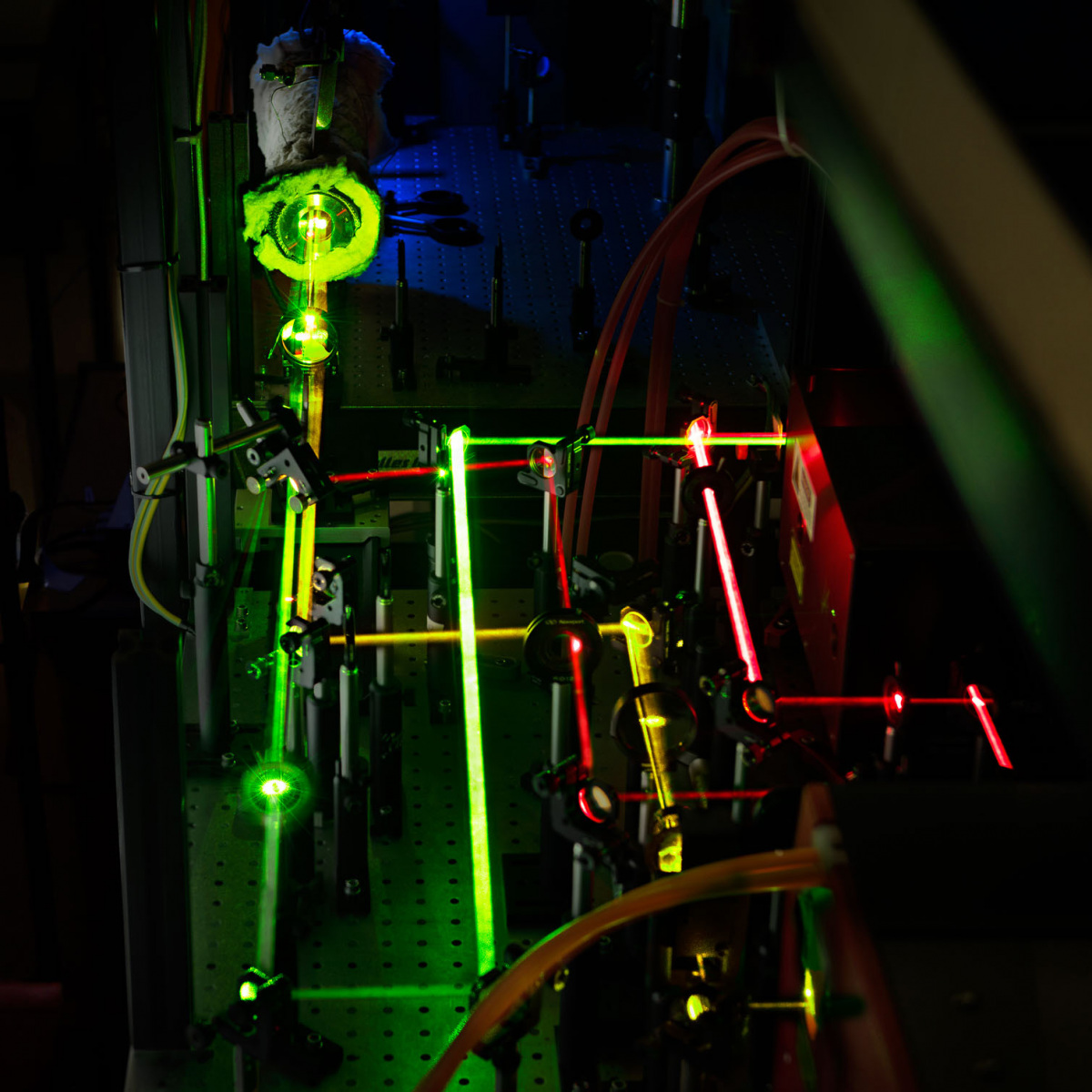
These images document the HITCHHIKER II passive radar setup within the radar laboratories at the Centre for Sensor Systems (ZESS), University of Siegen. For comprehensive research project details – including technical specifications, scientific publications, and contact information for the research group led by Dr Holger Nies at Prof Ivo Ihrke’s chair of Computational Sensorics/Communications Engineering – visit the HITCHHIKER project overview, or the dedicated HITCHHIKER website.