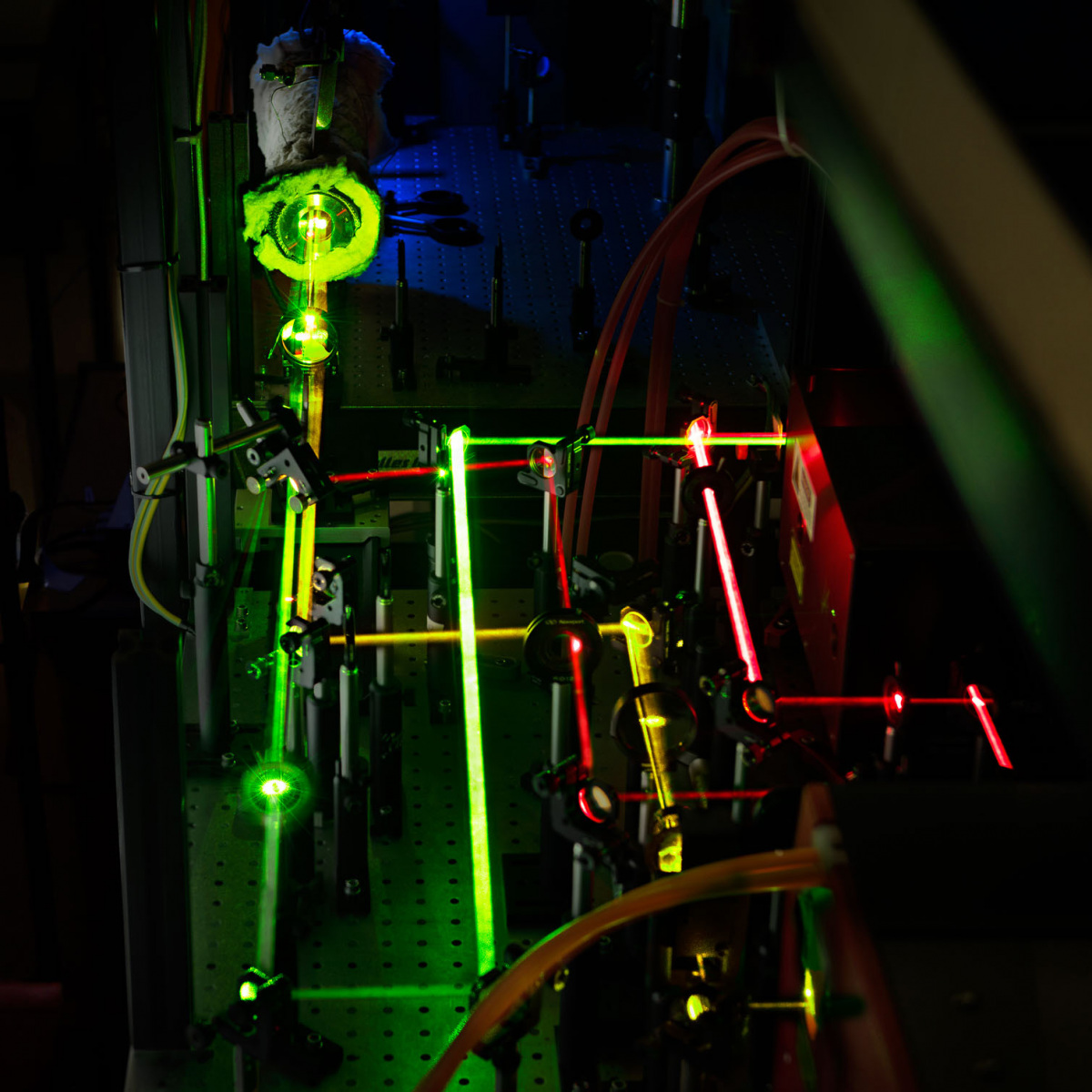
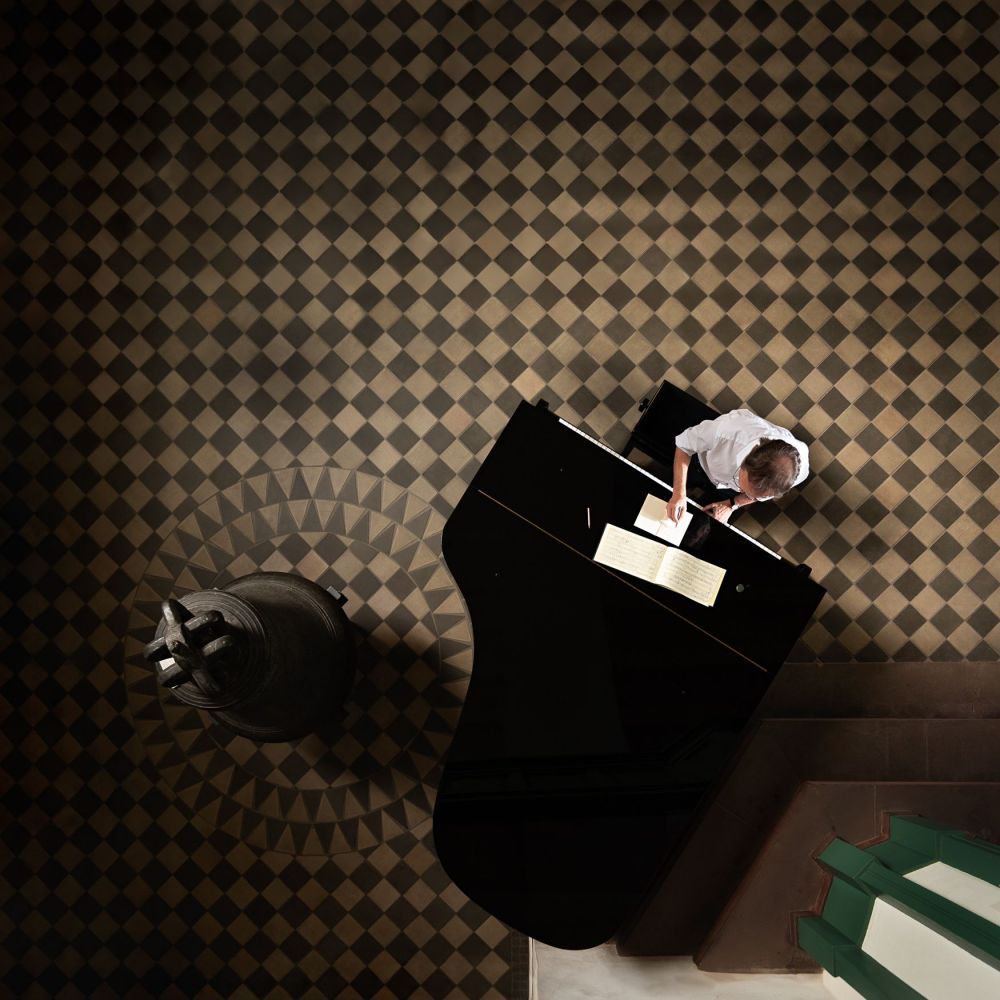
This project originated in the queue for a currywurst. While I was waiting with Stefan, the Lab Engineer from the PVD-Project, we found ourselves in a conversation with two strangers. One of them was Dr Kathrin Stahl, postdoctoral researcher at Professor Holger Foysi’s chair of fluid mechanics, and our discussion over a shared lunch led to a tour of Stefan’s labs at Prof Jiang’s chair of surface and materials technology, and then the wind tunnel Kathrin is working with.
The Architecture of Silence
When I stepped into the chamber, I was struck by two things. First, I had never experienced something as quiet and calm. While the experience can have a dizzying effect on people, I felt instant relaxation. And second, the visual potential of the space was immediate. The clear geometry of the room would provide for very clean framing and the expansive sheet metal cladding offered a surface for beautifully structured reflections. When I told Kathrin about my observations, the chance encounter between researchers over lunch quickly evolved into a coordinated production.
Methodical Geometry and Sound Pressure
In the wind tunnel, doctoral candidate Daniel Scholl, a member of Prof. Karsten Kluth’s research group in Work Science/Ergonomics, was going to conduct measurements on the acoustic exposure of motorcyclists.Daniel’s setup involved a naked bike, which is a raw and industrial object that would both suit the atmosphere and serve as an ideal visual anchor. A few weeks later, we were able to align my schedule and Daniel’s measurements. He planned to use in-ear microphones to map how velocity and posture influence sound pressure, collecting data that is vital for future helmet optimisation.
On shoot day, Daniel and Alexander Bald, the lab engineer supervising the wind tunnel, waited for me with a cheerful hands-on attitude. Daniel had already parked his meticulously prepared and spotlessly clean Suzuki 8S in the test section and to mirror the clear geometry and stillness of space and motorcycle, I opted for a top-down perspective – a creative decision resulting in a deliberately structured, slightly abstract composition. The angle required quite some work, but my collaborators demonstrated the characteristic patience of scientists, allowing the time required to align the camera’s optics with the physical symmetry of the chamber and the subject.
The Optical Daisy Chain
Lighting the interior of the semi-anechoic chamber presented a distinct set of optical challenges. I used more lights than I had radio triggers but at the same time positioned flashes in recesses that blocked the line-of-sight for slave mode, where flashes fire when they “see” other flashes go off. The solution was an optical daisy-chain, a manual workaround where more flashes were used as relays to trigger the ones lighting the scene, which was challenging because while they needed to maintain a visual line of sight to the other units, they had to stay invisible to the camera. A kind reminder that technical frictions are an unavoidable part of scientific work, as well as creative work.
Inside the Collector
To close the session, we had some time left for a final group shot, for which I was half-jokingly invited to climb into the collector, which I of course had to do instantly. From start to finish, the wind tunnel production was an incredibly enriching experience, proving once more that the most rewarding projects often stem from unplanned human connections and that shared meals paired with professional curiosity can lead to sophisticated outcomes. In the pursuit of empirical truth, as in the pursuit of aesthetics, the most profound insights often emerge only when we have the patience to let the noise subside.
Technical Background
Facility: Aero-acoustic Open-Jet Wind Tunnel (Closed Circuit), Prof Foysi’s chair of Fluid Mechanics, University of Siegen.
Specifications:
- Test section length: 2.24 m.
- Nozzle exit: 0.8 m × 0.8 m.
- Maximum flow velocity: Up to 70 m/s.
- Turbulence intensity in test area: < 0.5%.
- Environment: Semi-anechoic room with sound-absorbing lining (ISO 3745, f > 100 Hz).
Study Parameters:
- Subject: Naked Bike (Suzuki 8S)
- Equipment: In-ear microphone.
- Variables: Velocity, body posture (forward-leaning and upright), and presence/absence of a windscreen.
- Findings: Significant correlation between speed and ear-canal pressure; results provide a baseline for future product optimisation to reduce noise exposure in real-world riding conditions.